
Deprecated: Creation of dynamic property Timber\Site::$pingback is deprecated in /var/www/html/web/app/themes/ilsoftware/vendor/timber/timber/lib/Site.php on line 180

Deprecated: Creation of dynamic property Timber\User::$name is deprecated in /var/www/html/web/app/themes/ilsoftware/vendor/timber/timber/lib/User.php on line 118

Deprecated: Creation of dynamic property Timber\Post::$_edit_lock is deprecated in /var/www/html/web/app/themes/ilsoftware/vendor/timber/timber/lib/Core.php on line 71

Deprecated: Creation of dynamic property Timber\Post::$_edit_last is deprecated in /var/www/html/web/app/themes/ilsoftware/vendor/timber/timber/lib/Core.php on line 71

Deprecated: Creation of dynamic property Timber\Post::$onesignal_meta_box_present is deprecated in /var/www/html/web/app/themes/ilsoftware/vendor/timber/timber/lib/Core.php on line 71

Deprecated: Creation of dynamic property Timber\Post::$onesignal_send_notification is deprecated in /var/www/html/web/app/themes/ilsoftware/vendor/timber/timber/lib/Core.php on line 71

Deprecated: Creation of dynamic property Timber\Post::$onesignal_modify_title_and_content is deprecated in /var/www/html/web/app/themes/ilsoftware/vendor/timber/timber/lib/Core.php on line 71

Deprecated: Creation of dynamic property Timber\Post::$onesignal_notification_custom_heading is deprecated in /var/www/html/web/app/themes/ilsoftware/vendor/timber/timber/lib/Core.php on line 71

Deprecated: Creation of dynamic property Timber\Post::$onesignal_notification_custom_content is deprecated in /var/www/html/web/app/themes/ilsoftware/vendor/timber/timber/lib/Core.php on line 71

Deprecated: Creation of dynamic property Timber\Post::$_yoast_wpseo_focuskw is deprecated in /var/www/html/web/app/themes/ilsoftware/vendor/timber/timber/lib/Core.php on line 71

Deprecated: Creation of dynamic property Timber\Post::$_yoast_wpseo_metadesc is deprecated in /var/www/html/web/app/themes/ilsoftware/vendor/timber/timber/lib/Core.php on line 71

Deprecated: Creation of dynamic property Timber\Post::$_yoast_wpseo_linkdex is deprecated in /var/www/html/web/app/themes/ilsoftware/vendor/timber/timber/lib/Core.php on line 71

Deprecated: Creation of dynamic property Timber\Post::$_yoast_wpseo_content_score is deprecated in /var/www/html/web/app/themes/ilsoftware/vendor/timber/timber/lib/Core.php on line 71

Deprecated: Creation of dynamic property Timber\Post::$_yoast_wpseo_estimated-reading-time-minutes is deprecated in /var/www/html/web/app/themes/ilsoftware/vendor/timber/timber/lib/Core.php on line 71

Deprecated: Creation of dynamic property Timber\Post::$_yoast_wpseo_wordproof_timestamp is deprecated in /var/www/html/web/app/themes/ilsoftware/vendor/timber/timber/lib/Core.php on line 71

Deprecated: Creation of dynamic property Timber\Post::$tipologia is deprecated in /var/www/html/web/app/themes/ilsoftware/vendor/timber/timber/lib/Core.php on line 71

Deprecated: Creation of dynamic property Timber\Post::$_tipologia is deprecated in /var/www/html/web/app/themes/ilsoftware/vendor/timber/timber/lib/Core.php on line 71

Deprecated: Creation of dynamic property Timber\Post::$attributi is deprecated in /var/www/html/web/app/themes/ilsoftware/vendor/timber/timber/lib/Core.php on line 71

Deprecated: Creation of dynamic property Timber\Post::$_attributi is deprecated in /var/www/html/web/app/themes/ilsoftware/vendor/timber/timber/lib/Core.php on line 71

Deprecated: Creation of dynamic property Timber\Post::$in_evidenza_newsletter is deprecated in /var/www/html/web/app/themes/ilsoftware/vendor/timber/timber/lib/Core.php on line 71

Deprecated: Creation of dynamic property Timber\Post::$_in_evidenza_newsletter is deprecated in /var/www/html/web/app/themes/ilsoftware/vendor/timber/timber/lib/Core.php on line 71

Deprecated: Creation of dynamic property Timber\Post::$inviato_in_newsletter is deprecated in /var/www/html/web/app/themes/ilsoftware/vendor/timber/timber/lib/Core.php on line 71

Deprecated: Creation of dynamic property Timber\Post::$_inviato_in_newsletter is deprecated in /var/www/html/web/app/themes/ilsoftware/vendor/timber/timber/lib/Core.php on line 71

Deprecated: Creation of dynamic property Timber\Post::$_yoast_wpseo_primary_category is deprecated in /var/www/html/web/app/themes/ilsoftware/vendor/timber/timber/lib/Core.php on line 71

Deprecated: Creation of dynamic property Timber\Post::$_yoast_wpseo_primary_content_type is deprecated in /var/www/html/web/app/themes/ilsoftware/vendor/timber/timber/lib/Core.php on line 71

Deprecated: Creation of dynamic property Timber\Post::$_yoast_wpseo_primary_attributes is deprecated in /var/www/html/web/app/themes/ilsoftware/vendor/timber/timber/lib/Core.php on line 71

Deprecated: Creation of dynamic property Timber\Post::$_yoast_wpseo_primary_speciali is deprecated in /var/www/html/web/app/themes/ilsoftware/vendor/timber/timber/lib/Core.php on line 71

Deprecated: Creation of dynamic property Timber\Post::$_thumbnail_id is deprecated in /var/www/html/web/app/themes/ilsoftware/vendor/timber/timber/lib/Core.php on line 71

Deprecated: Creation of dynamic property Timber\Post::$response_body is deprecated in /var/www/html/web/app/themes/ilsoftware/vendor/timber/timber/lib/Core.php on line 71

Deprecated: Creation of dynamic property Timber\Post::$status is deprecated in /var/www/html/web/app/themes/ilsoftware/vendor/timber/timber/lib/Core.php on line 71

Deprecated: Creation of dynamic property Timber\Post::$newsletter_subject is deprecated in /var/www/html/web/app/themes/ilsoftware/vendor/timber/timber/lib/Core.php on line 71

Deprecated: Creation of dynamic property Timber\Post::$_newsletter_subject is deprecated in /var/www/html/web/app/themes/ilsoftware/vendor/timber/timber/lib/Core.php on line 71

Deprecated: Creation of dynamic property Timber\Post::$newsletter_summary is deprecated in /var/www/html/web/app/themes/ilsoftware/vendor/timber/timber/lib/Core.php on line 71

Deprecated: Creation of dynamic property Timber\Post::$_newsletter_summary is deprecated in /var/www/html/web/app/themes/ilsoftware/vendor/timber/timber/lib/Core.php on line 71

Deprecated: Creation of dynamic property Timber\Post::$post_date_gmt is deprecated in /var/www/html/web/app/themes/ilsoftware/vendor/timber/timber/lib/Core.php on line 71

Deprecated: Creation of dynamic property Timber\Post::$comment_status is deprecated in /var/www/html/web/app/themes/ilsoftware/vendor/timber/timber/lib/Core.php on line 71

Deprecated: Creation of dynamic property Timber\Post::$ping_status is deprecated in /var/www/html/web/app/themes/ilsoftware/vendor/timber/timber/lib/Core.php on line 71

Deprecated: Creation of dynamic property Timber\Post::$post_password is deprecated in /var/www/html/web/app/themes/ilsoftware/vendor/timber/timber/lib/Core.php on line 71

Deprecated: Creation of dynamic property Timber\Post::$post_name is deprecated in /var/www/html/web/app/themes/ilsoftware/vendor/timber/timber/lib/Core.php on line 71

Deprecated: Creation of dynamic property Timber\Post::$to_ping is deprecated in /var/www/html/web/app/themes/ilsoftware/vendor/timber/timber/lib/Core.php on line 71

Deprecated: Creation of dynamic property Timber\Post::$pinged is deprecated in /var/www/html/web/app/themes/ilsoftware/vendor/timber/timber/lib/Core.php on line 71

Deprecated: Creation of dynamic property Timber\Post::$post_modified is deprecated in /var/www/html/web/app/themes/ilsoftware/vendor/timber/timber/lib/Core.php on line 71

Deprecated: Creation of dynamic property Timber\Post::$post_modified_gmt is deprecated in /var/www/html/web/app/themes/ilsoftware/vendor/timber/timber/lib/Core.php on line 71

Deprecated: Creation of dynamic property Timber\Post::$post_content_filtered is deprecated in /var/www/html/web/app/themes/ilsoftware/vendor/timber/timber/lib/Core.php on line 71

Deprecated: Creation of dynamic property Timber\Post::$guid is deprecated in /var/www/html/web/app/themes/ilsoftware/vendor/timber/timber/lib/Core.php on line 71

Deprecated: Creation of dynamic property Timber\Post::$menu_order is deprecated in /var/www/html/web/app/themes/ilsoftware/vendor/timber/timber/lib/Core.php on line 71

Deprecated: Creation of dynamic property Timber\Post::$post_mime_type is deprecated in /var/www/html/web/app/themes/ilsoftware/vendor/timber/timber/lib/Core.php on line 71

Deprecated: Creation of dynamic property Timber\Post::$comment_count is deprecated in /var/www/html/web/app/themes/ilsoftware/vendor/timber/timber/lib/Core.php on line 71

Deprecated: Creation of dynamic property Timber\Post::$filter is deprecated in /var/www/html/web/app/themes/ilsoftware/vendor/timber/timber/lib/Core.php on line 71
Link aggregation: cos'è e come sfruttarla | IlSoftware.it

Link aggregation: cos'è e come sfruttarla

Anche nell'era del Multi Gigabit, la link aggregation risulta utile per massimizzare la banda disponibile tra il router e un dispositivo collegato a valle, ad esempio un server NAS.

Quando si parla di networking, è utile conoscere tutte le potenzialità del proprio router. La link aggregation non è una funzione che si trova su tutti i dispositivi e nei router non destinati al mercato business è comunque meno robusta. In ogni caso permette di aumentare la larghezza di banda disponibile, migliorare la tolleranza ai guasti e ottimizzare l’utilizzo delle risorse di rete. Vediamo più da vicino di che cosa si tratta e come sfruttarla.

Sebbene sia possibile utilizzare la link aggregation per una connessione WAN (WAN Link Aggregation), il concetto è molto diverso da quello di Dual WAN, sul quale ci siamo soffermati in un altro articolo. I termini link aggregation e Dual WAN non sono quindi intercambiabili e fanno riferimento ad aspetti e funzionalità differenti.

Come abbiamo già visto, è possibile utilizzare Dual WAN, conosciuto anche come WAN bonding, quando si dispone di due connessioni Internet separate per abilitarle entrambe con lo stesso router. In questo caso è possibile configurare la funzione Dual WAN per il bilanciamento di carico oppure per il failover (la seconda connessione è attivata quando la prima non funziona).

La link aggregation, nota anche come link bundling o link bonding è una tecnica utilizzata nei router e negli switch di rete per combinare più collegamenti fisici in un unico canale logico. Sebbene alcuni router utilizzino metodi proprietari, la link aggregation generalmente si basa sullo standard IEEE 802.3ad (Link Aggregation Control Protocol, LACP). Spesso è questo l’unico standard disponibile e utilizzabile.

Quando vengono aggregate, le porte fisiche operano come un unico canale virtuale ad alta velocità. I pacchetti di dati vengono suddivisi tra le diverse porte fisiche utilizzando algoritmi di bilanciamento del carico, come ad esempio in base all’indirizzo MAC o all’indirizzo IP di origine o destinazione. Ciò consente di sfruttare in modo più efficiente la larghezza di banda complessiva e di bilanciare il carico di traffico sulla rete.

In parole semplici, la link aggregation combina due porte di pari velocità in un unico collegamento. Esse vanno a formare un Link Aggregation Group (LAG). Nelle applicazioni di livello consumer, lo standard 802.3ad si applica solo alle porte Gigabit. Prima dell’era Multi-Gig, una connessione LAG era l’unico modo semplice per ottenere una connessione capace di muovere una banda notevolmente maggiore.

Porte Multigigabit (Multi-Gig) e LAG

Partendo da quanto abbiamo descritto nell’articolo dedicato all’approccio Multigigabit Ethernet, si possono ad esempio unire due porte Gigabit (1 GbE) per ottenere un link (LAG) a 2 Gbps. Così facendo la banda disponibile raddoppia e si possono sfruttare capacità di failover (se una porta dovesse guastarsi o fosse scollegata, si ha comunque una banda massima pari a 1 Gbps).

È importante notare che sebbene sia possibile utilizzare una porta Multi-Gig (ad esempio 10 GbE) come parte di un LAG, essa funzionerà in modalità Gigabit sui router non destinati al mercato business. Combinando una porta Multi-Gig da 10 Gbps e una porta Gigabit (1 GbE), si ottiene comunque una connessione da 2 Gbps. Questa opzione è applicabile quando non si dispone di porte Multi-Gig su entrambe le estremità di un collegamento.

Se un dispositivo, ad esempio un server, è equipaggiato con più porte LAN, è possibile collegarle tutte a una rete. Soltanto una delle porte risulta attiva in un determinato momento quando non si usa la link aggregation: le altre restano in standby. La larghezza di banda tra il dispositivo e la rete è pari a quella di una qualunque delle porte: spesso corrisponde alla porta collegata per ultima. La link aggregation risulta quindi necessaria se si desidera sfruttare più di una porta contemporaneamente. Alcuni router e switch permettono di abilitare due LAG mentre altri uno solo.

Creare un LAG è piuttosto scomodo perché sono richiesti più cavi Ethernet. Affinché la link aggregation funzioni, è inoltre necessario dotarsi di un router (o di uno switch) e di un dispositivo collegato a valle che la supportino. La maggior parte dei server NAS, utilizzati per lo storage dei dati e per un ampio ventaglio di applicazioni avanzate, offre più porte LAN e permette di attivare la link aggregation.

Supponendo di avere a disposizione dispositivi compatibili 802.3ad, ad esempio un router e un NAS, l’attivazione della LAN link aggregation è molto semplice. Noi la utilizziamo da anni per massimizzare la velocità dei trasferimenti dati da e verso i nostri server NAS locali, ampiamente utilizzati ai fini di backup.

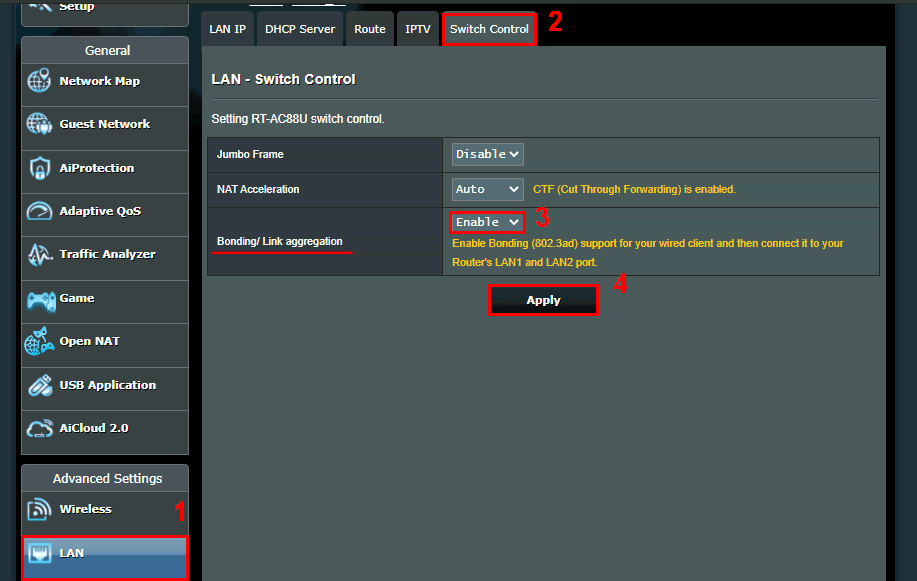
Come primo passo va configurato il LAG sul router accedendo al suo pannello di amministrazione Web. In molti casi, il router consente di abilitare la link aggregation sulle porte LAN1 e LAN2. A queste ultime vanno connessi i cavi di rete per collegare il dispositivo client a valle.
Link aggregation router

Nell’immagine, la creazione di un LAG sulle porte LAN1 e LAN2 di un router ASUS. Per procedere, basta accedere alla sezione LAN (1), selezionare la scheda Controllo switch (2), attivare la voce evidenziata in figura (3) e infine cliccare su Applica (4).

Sul dispositivo connesso al router attraverso la coppia di cavi Ethernet è quindi possibile attivare la link aggregation: spesso è necessario portarsi all’interno del suo pannello di controllo quindi attivare la modalità Balance-TCP, un nome diverso per i LAG 802.3ad.

Sebbene i dispositivi Multi-Gig siano oggi una realtà piuttosto diffusa, la creazione di un LAG è una tecnica ampiamente utilizzata in ambienti di rete ad alta intensità di traffico per ottimizzare le prestazioni e la disponibilità della rete.

Credit immagine in apertura: iStock.com/CHUYN

Ti consigliamo anche

Link copiato negli appunti